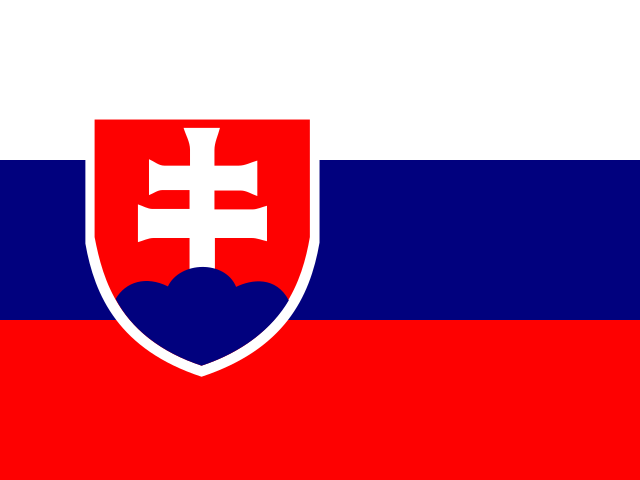
The government cloud is a hybrid platform that brings together registered cloud services into a unified ecosystem for the state. A talk by Roman Gelien from MIRRI showed what challenges public administration is addressing and how the cloud helps manage them. Cloud credits and the Dynamic Purchasing System play a key role.
What is the government cloud and why do we need it
The government cloud represents cloud computing in the form of a hybrid environment composed of services listed in an official catalog. Its goal is to safely and efficiently provide standardized services to public administration authorities. In practice, this means common rules, oversight, and easier access to modern technologies.
The public sector faces pressure for efficiency, security, and flexibility, while being slowed by a complex and time-consuming procurement process. There is a shortage of IT specialists, and smaller institutions struggle with standards and certifications that are demanding in terms of both time and budget. On the other hand, the cloud brings lower total costs, scalability, faster project start-up, high availability, and real-time metrics.
Cloud credits and purchasing via DNS
Cloud credits act as a digital currency that institutions use to pay for resources and services in the cloud. They can be used for compute, storage, or other services, with the balance decreasing according to actual consumption. Another advantage is carryover between years and the ability to procure an entire set of cloud services, not just a specific item.
The Dynamic Purchasing System (DNS) is a fast, flexible, and transparent way to buy commonly available goods and services, including cloud credits and resources. The procedure is simple: a supplier registers and can then participate in all tenders. The whole process takes up to 45 days and reduces administrative burden, enabling managing authorities to quickly secure both funding and resources for projects.
SK Cloud in practice: public and private parts
The MIRRI initiative called SK Cloud has both a public and a private part. The public cloud is already up and running thanks to DNS and supports projects of institutions that have chosen this path. The private cloud is being prepared in a state data center within Slovakia to respond to the specific needs of the managing authorities.
For public administration, this means relief from infrastructure and maintenance, fast delivery, and the implementation of more than 300 services across leading providers. Emphasis is placed on governance, cloud‑ready and cloud‑native approaches, infrastructure-as-code automation, and compliance with ISO standards and regulations, including readiness for artificial intelligence services. Speed has also been demonstrated in practice: from the DNS call to the opening of bids took 20 days, and the environment for consuming credits was ready in less than one day.
Among the first projects in the public government cloud are ITAM Asset Management, Meta IS 3.0, the consolidated analytics layer, Digital Seniors, Virtual Classroom, Open Data 2.0, and OTS. Other organizations have also expressed interest in using the public part of SK Cloud, for example 155, ŠÚKL, and the Office for the Supervision of Health Care.