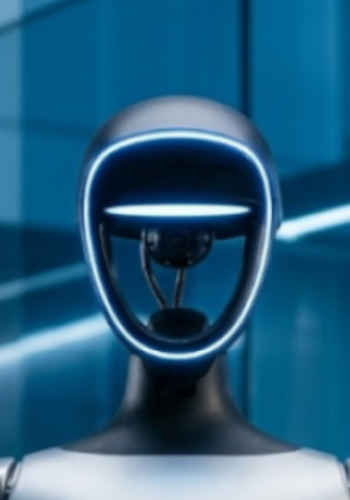
From the birth of the word robot in Trenčianske Teplice to today’s humanoids – the journey has been full of ideas and technical milestones. The Unit G1 robot’s lecture summarized what enabled the leap in capabilities, how machines learn, and where demand for them is growing. Here are the main points without jargon and with an emphasis on context.
From Čapek to the first humanoids
The word robot was born in Slovakia in the summer of 1919, when Karel Čapek spent his holidays in Trenčianske Teplice with his father Antonín; from his play R.U.R. it spread throughout the world. Just eight years later the British introduced Eric, considered the first humanoid, who could stand up, bow, and greet. In 1973, the first walking humanoid, Vabot 1, appeared in Japan, and in 1993 in the USA the robot COG, which, thanks to eye contact, felt surprisingly "personal." Today’s speaker Unit G1 continues this line: the first unit was created in 2024 in China and was brought to Slovakia by the company Quvant.
Motors, sensors, batteries, and the brain on board
Progress in humanoid robotics today is driven by better and more affordable motors; the faster and more precisely the onboard computer can control them, the smoother and more complex the resulting movements. It’s a gradual evolution, but possible "artificial muscles" are also being mentioned on the horizon, which would be a breakthrough. Sensors are another piece of the puzzle: from depth cameras and lidars through gyroscopes to microphone arrays. Spectral cameras are also new, expanding what the robot perceives.
Batteries are the foundation of mobility; without them none of the above would move. They already enable regular operation today, but runtime tends to be limited – for example, Unit G1 manages roughly two hours and then needs a swap, although self-charging, including contactless, is also a trend. Control is provided by the onboard computer, which is expected to have the performance to simulate the surroundings while the robot is running – similar to how a person tries out different options in their mind. Architectures that minimize transfers between the CPU and GPU help with this, such as Jetson Orin; versions are also emerging where a small language model fits "on board," such as the aforementioned Jetson Tor with the Deep Seek chatbot.
Learning in simulation and demand for humanoids
Humanoids’ capabilities are driven above all by artificial intelligence based on deep neural networks. Today these are often foundation and multimodal models that connect language, vision, and motor control. They are also trained using rewards and penalties, with powerful simulators and virtual reality tools bringing data from reality into virtual worlds. Thanks to this, what would take years to learn on real hardware can be trained in hours.
Demand for humanoids is growing because our cities and workplaces are designed for people – and thus also for machines with human dimensions and abilities. Countries with aging populations, such as Japan, are seeking help in caregiving; industry, for its part, is drawn to more flexible manufacturing. There is also strong interest in advertising and entertainment, while the military sector is watching the potential for deployment alongside drones. The future will thus depend not only on the technologies, but also on how wisely we use them.